Friday, March 23, 2018

Amazon applies for a new patent for drones

March 23 quoted GeekWire news, Amazon has submitted a patent for the delivery of drones. Drones can recognize human gestures and respond accordingly. For example, the gestures identified by the drone include waving arms, pointing, flashing lights, and speaking.

The patent states that human recipients and/or other humans can use human gestures to communicate with the drone to help the drone follow its path to the delivery site. The patent shows that the drone will recognize human gestures, including welcome and dangerous gestures. If a person waves in a welcome manner, the drone can interpret the gesture as an instruction to deliver the package."

drone

The patent details several components of a drone, including communications, navigation, gesture determination, and delivery components. The drone will also have one or more light sensors, depth sensors, visible light cameras, infrared cameras, audio sensors and depth-sensing cameras. Although the drone concept is impressive, it is still only a patent, and it is not yet clear whether the drone will be produced. Amazon also submitted other patents that have not yet been converted into products, including a self-destructive drone and a mirror that allow users to wear virtual clothing.

The concept of drones that can respond to human interactions is not new. Samsung also has a similar UAV patent that can detect human faces and gestures. DJI's Spark drone can also respond to human gestures.

The application time for this patent was July 2016, and was disclosed this week. According to the patent description; "The human parcel receiver can use gestures to communicate with the drone to help the drone follow the path to the delivery point." The patent demonstrates the drone's "refuse" mode when the drone recognizes the "refuse" gesture, it will no longer be close to the gesture sender and adjust its speed and direction. When it recognizes the "welcome" gesture, the drone thinks it should deliver to the sender of the gesture.

Although the patent appears to be very powerful, it is still only a patent after all. It is not yet clear that the if the patent will be produced. 

RC Helicopters are so popular around the world now

RC helicopters are prototype aircraft available in contrasting varieties and compositions. Some have been manufactured for greater maneuverability although these types have decreased acrobatic control. The remote control helicopters are operated by the users using the remote control because of the tiny servomotors that were placed on a particular part of the aircraft. Most people who operate RC helicopters do this for fun. Some people also use them for photography, filming, remote inspection, and police surveillance.

RC Helicopter

The RC Helicopter usually made by experts and there are three categories available for purchase by enthusiasts as well as people in professions that require the use of RC helicopters. The first category is the nitro helicopters that most people prefer and are available in different sizes, size being a standard measure of the nitro-engine that is mounted in the aircraft. The nitro model is able to fly for about seven to 15 minutes.

RC electric helicopters are becoming popular among newcomers. These aircraft are mechanized through the use of Lithium Polymer batteries and can fly for about four to fourteen minutes. There is the third category of RC gas turbine helicopters that are very expensive and are also less popular because they are expensive. People who have acquired the skills to control these devices will tell you that it is not easy to become competent. Most of the time, the ability to become an expert in RC helicopter control will depend on the design of a particular helicopter, chopper controls and maneuvers that the helicopter is capable of performing.

While RC helicopters are generally used by amateurs, they will have a look completely similar to real helicopters although the category of toys has a different structure that gives it distinctive functions. The toy-type remote-controlled helicopters were made to have a more balanced combat to help children use the transmitters more easily and give them more control over the flights. Electric toy helicopters are therefore unable to operate at the speed and maneuverability of helicopters built for adult RC helicopter enthusiasts. Children, as well as older enthusiasts, will appreciate each helicopter category with equal enthusiasm.

The radio control helicopters have transmitters and that is where any action you take when you fly the helicopter is introduced. Each helicopter will have many channels and these are the channels that determine the number of maneuvers you can do when you control the helicopter. Most will have four controls in the least. Left and right cyclic controls give the helicopter the ability to turn. The front and rear controls give the helicopter its speed.

Tuesday, March 20, 2018

An overall DJI Mavic Air review for you - part 3

Although it looks like a toy, the Mavic Air is sturdy and well built. The recessed gimbal, with its snap-on camera cover, adds a layer of protection, making it a perfect travel companion. However, putting the cover back in place after use can be a little tricky, with no perfect way to put it back in place. You only need to make sure that the camera is facing straight ahead or that the cover is not aligned properly to slide into position.

DJI Mavic Air

Taking a page from Spark's design, DJI launched the Mavic Air in three colors: white, black and red. Although colors are a fun touch, we found that the red and black versions were fingerprint magnets. The white version is the best, but it can be lost more easily at a distance against a clear sky.

The DJI Mavic Air is the first DJI drone to introduce USB-C for content transfer. Unfortunately, the USB port can not be used to charge the drone. For this, you will need to transport the proprietary charger. Of course, it also comes with a micro SD card slot, but this time there is also 8GB of storage on board. Thus, if you forget to have a card or if you manage to fill it very quickly, you can continue to take pictures with a single tap.

Another remarkable but simple innovation that adds to the portability of the new drone is the redesigned remote control. Out of the box, the joysticks for the controller are neatly stored under the collapsible clips of the smartphone, giving the new controller a flat surface that allows it to slide into the pocket at the back of the drone case. Simply remove and screw them, then unscrew them and put them away as you see fit.

The controller does not have the integrated display of the Mavic Pro remote control for flight telemetry, but you can insert your smartphone into the foldable clips and, also, you have access to a live video stream and all other information piloting that you need.

An overall DJI Mavic Air review for you - part 2

Given the limited flying time of most drones, you might want to consider investing in multiple batteries if you want to fully experience the flight experience of a drone. To get out of the ordinary with the Mavic Air, DJI offers the Fly More Combo for $ 999 / £ 949 / AU $ 1,599. It includes the drone, three batteries, a remote control, a travel bag, two pairs of protective propellers, six pairs of propellers, a battery-bank adapter and a battery charge concentrator. These different combos basically can satisfy all the needs from different users.

Even if the starting price is a high investment for a gadget with a range of 21 minutes, the improved technology housed in the elegant chassis makes the DJI Mavic Air very attractive, especially since it is less expensive than its big brother. And, unlike the Spark, it comes with its own dedicated controller, which largely justifies the cost.

DJI Mavic Air

Design and build
Compact and foldable form factor efficiency
The recessed gimbal adds protection, but the clip-on cover is awkward.
Removable joysticks on the redesigned controller.

USB-C port for data transfer only
The Mavic Air can look like the Spark in terms of size, but that's where the similarity ends. The arms of the new drone are foldable, like those of the Mavic Pro, bringing portability to a whole new level. 

Perfectly folded in your pocket 
Once folded, the Mavic Air can easily fit into a large pocket - think of cargo pants or a big jacket. Weighing 430g, it is heavier than the 300g Spark but lighter than the 743g Mavic Pro, and certainly lighter than a pint of beer. The drone zipper case adds to its small size - it slips easily into a backpack or camera bag with plenty of room for the rest of the gear.

An overall DJI Mavic Air review for you - part 1

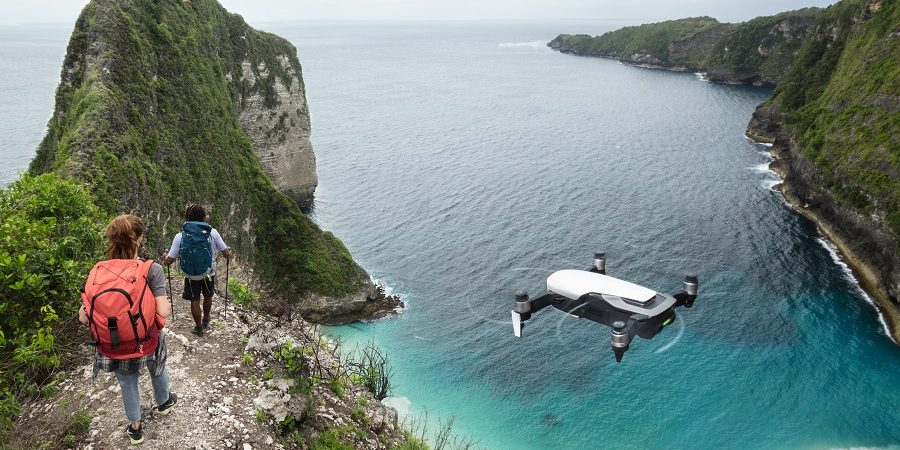
DJI's commitment to innovation is reflected in the company's latest consumer drone: Mavic Air, which is the child of the almost perfect Mavic Pro and the compact and user-friendly Mavic Pro Spark. By taking the technology and foldable rotor arms of the Mavic Pro and the small form factor and playfulness of the Spark - and then improving both - DJI has produced its best drone so far for consumers.

DJI Mavic Air

DJI Mavic Air at Amazon Marketplace for $ 799.
Update: We have updated our review DJI Mavic Air to note the battery life of the controller and the battery charge time of the drone and the controller.

The DJI Mavic Air flies over this perfect middle ground, offering premium features at a lower price than the Mavic Pro. It has pretty much all the bells and whistles (although this drone certainly buzzes) that you could ask for, 4K video and 32MP panoramic shots at a 21-minute range. Most importantly, the DJI Mavic Air is easy to control thanks to an improved object avoidance and gesture control system, which makes this drone more popular.

$ 999 (£ 949, AU $ 1,599) for the Fly More Combo.
Comparison: Mavic Pro is $ 999 (£ 1,099, AU $ 1,599); Spark is $ 399 (£ 449, AU $ 649).
With a starting price of $ 799 / £ 769 / AU $ 1,299, the Mavic Air is cheaper than its big brother Pro. By paying this price, you get the drone, a battery, the owner charger, the redesigned remote control, a small carrying case, four propeller guards and two complete sets of propellers. So which means, basically all the necessary accessories you will need. And since all the official DJI products are in high quality and worth trusting, you don’t need to waste more time and money to purchase other products anymore. In this way, this investment, in fact, is quite cost-effective.

Monday, March 12, 2018

DJI Mavic Pro Critic - part 3

DJI Mavic Pro - Performance
How does the Mavic fly? Effortless - and fast. Flick in Sports Mode, and it will hit frankly scary 40mph (at a loss from this obstacle collision, mind), but even with its regular settings, it's a responsive flyer, spry, instantly acting on your control inputs. Despite this speed, it is also possible to make precise changes, which is important if you are difficult on your images.

dji mavic pro

It also rises and falls to a fast-paced speed, allowing you to set it up for aerial shots and important videos without consuming too much battery life. The actual battery life accurately reflects DJI's claims, so in normal mode, you can expect approximately 27 minutes of air time per charge (and much less in energy-hungry sports mode). Restoring an empty battery at full charge takes about an hour, so it might be worth investing in extra batteries (at £85 per battery) if you plan long driving sessions.

Images and photos, meanwhile, look excellent. The 4K videos are so crisp that you will not believe they come from such a small camera, while the 1080p clips do not have that impact, but compensate with a fluidity of 60 fps that in some case, you may be better. That said, even with the 30 frames per second that 4K clips run, I did not notice any major issues with the shutter - just a slight shudder when panning. 

12 megapixel JPEG files also have a glorious impact - although zooming in on your computer's screen reveals that the images are the clearest or most crisp. You can also shoot in RAW, which should allow you to edit and "fix" problematic photos.

DJI has also released an updated model of dji mavic pro, called Mavic Pro Platinum. This has 60% quieter rotors and a 30 minute flight time.


DJI Mavic Pro Critic - part 2

DJI Mavic Pro - Features
The camera is small but quite powerful on paper: its 1 / 2.3-inch sensor can capture 12MP images in JPEG or DNG RAW format, as well as videos at different resolutions and frame rates: 4K at 30fps or 1080p at 96fps.

It is mounted on a small motorized gimbal that, in combination with the drone's sensor suite, can make almost instant adjustments to stay level all the time. You can also set it to a POV mode, which tilts and rotates with the drone.

dji mavic pro

There are four other cameras on board, but these are not meant for photography. They must promote stability and safety in flight. Two down-facing cameras prevent the dji mavic pro drone from drifting indoors or in areas of poor GPS coverage (usually, GPS data is used to maintain the position), while another pair faces the front and prevents the drone from hitting them. It will stop moving if it is a few feet from any solid object, but only when it is in front - the obstacle detection will not prevent a crash if the Mavic moves back or falls laterally in a tree, a lamppost or neighbor's window. So beware.

Then there's the little controller, which unfolds to accommodate an Apple or Android smartphone in its socket - the phone plugs into the controller with a short cable, and the controller automatically connects to the Mavic via Wi-Fi or RC. In this way, you can see the live stream of the drone camera (in 1080p) and change the settings via the DJI Go app on your phone screen while keeping the physical flight controls at your fingertips.

dji mavic pro

It also has a long transmission range - DJI says up to 4.3 miles, depending on obstacles and other interference. I did not try to test that, because flying a drone beyond the visual range would break British law.

If you want to use a tablet or phone too big to fit in the handle, there is a full size USB port at the bottom of the controller. Plug in your device there, and it will work the same way as a phone - but a lot more awkwardly, because you will need to support the screen somewhere while holding the controller.